




The Hong Kong Planning Unit arranged emergency subsidiary notes before and around the end of the Second World War so that small transactions could resume after liberation. Coin supplies remained inadequate, and new coins did not reach Hong Kong until February 1949.
A new postwar format
Catalogued as P-321 and ND (1945), the brown-toned one-cent note measures about 89 × 41 mm. Its face is centred on George VI, with the Government name and denomination arranged for immediate recognition.
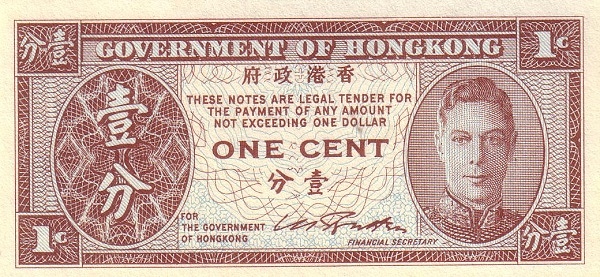
Unlike the crown-led P-313 of 1941, P-321 has no individual serial number and is printed on one side only. The portrait and unnumbered format signal a deliberate break from the locally printed wartime series.
Attribution without serials
Because P-321 is unnumbered, attribution does not depend on a prefix or serial sequence. The George VI portrait, one-cent denomination, brown palette, approximate dimensions and blank reverse should be considered together.
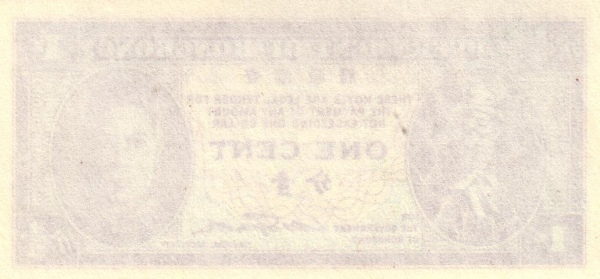
The reverse was intentionally left blank. Paper tone, folds, offset traces or the imaging background may still appear in a scan, but they do not constitute a reverse design; this uniface construction is fundamental to identifying the issue.
Collector's perspective
The narrow 41 mm height makes the long upper and lower edges vulnerable to small splits and uneven trimming. On a brown-toned example, examine whether washing has lightened the portrait or changed the natural paper texture, and record pinholes or repairs visible from the blank back.
With no serial to individualise the note, complete margins, clear portrait detail and undisturbed paper are particularly useful descriptive points. The blank reverse often makes thinning, mounting residue and reinforced folds easier to detect.
Why one cent continued
The five- and ten-cent emergency notes were displaced when coin supplies resumed around 1949, but production of one-cent coins did not restart. Paper one cent therefore remained useful and later passed to the Elizabeth II portrait series in 1961, giving this George VI type a pivotal place between wartime and long-running postwar issues.