



Wartime pressure and rapid population growth left Hong Kong short of coins for everyday transactions. The Government therefore authorised the local printer Noronha and Company Limited of Old Bailey Street to produce paper substitutes in one-, five- and ten-cent denominations.
Design and production
The approximately 75 × 42 mm note has a brown face and red reverse. A crown, rather than a monarch's portrait, anchors the design; the printed signature of Financial Secretary R.R. Todd and an individual serial number identify it as part of the locally produced 1941 series.
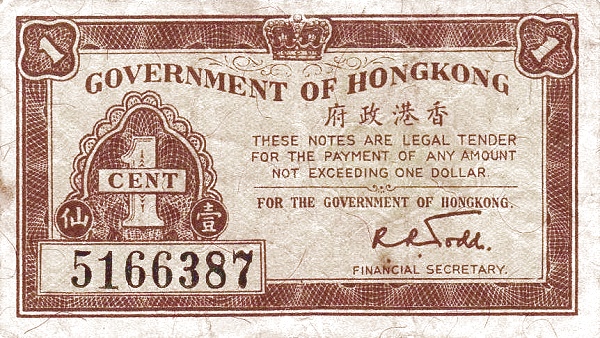
Released on 30 May 1941, the one-cent note preceded the five- and ten-cent values by more than four months. Its compact format suited the lowest denomination, while the contrasting face and reverse colours helped distinguish the two printed sides.
Catalogue varieties
The serial prefix is the clearest subtype distinction: P-313a has no prefix, P-313b carries A, and P-313c carries B. The letter should be read together with the complete number, not inferred from colour or wear.
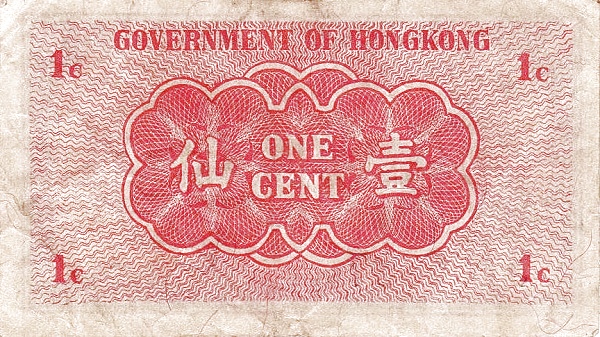
This is a genuinely two-sided note: the red reverse is an intentional printed design, not show-through from the face. That feature sharply separates P-313 from the unnumbered, uniface George VI one-cent note introduced after the war.
Collector's perspective
On this very small note, check whether the full border, crown and serial remain intact. Edge nicks can quickly intrude into the design, and cleaning may weaken the brown face or red reverse; record folds, pinholes, thinning and repairs without relying on an artificially flattened appearance.
For attribution, a clear image of the entire serial area is especially useful because a missing or obscured prefix can change the catalogue listing. Matching wear and paper tone on both sides also helps document the note as a complete circulated object.
Historical significance
P-313 matters as the opening denomination of a locally printed wartime response. Japanese occupation began in December 1941 and interrupted normal circulation only months after release; the postwar successor retained the one-cent value but replaced serialled, two-sided production with a portrait-led uniface format.