

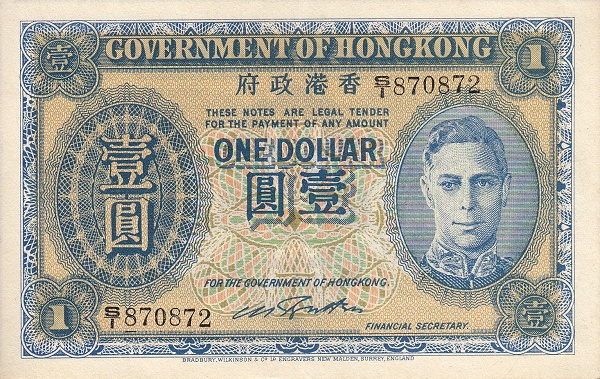
The light-blue George VI Government $1 is known as the “Blue Emperor” (藍皇). It retains the established Bradbury Wilkinson design: George VI at right, bilingual government titles and no printed date. Catalogues commonly identify it as Pick 316, ND (1940–1941).
Its chronology needs a little context. Catalogue attribution points to 1940–1941, but local historical accounts describe the blue Government $1 as the issue used when note circulation resumed in 1945 after the Japanese occupation. Because the note is undated, these are best understood as two cataloguing and historical perspectives on the same blue type.
War, occupation and return
Japanese occupation began in December 1941 and interrupted normal Hong Kong currency circulation. A Bank of China $5 note overprinted “香港政府壹圓” in 1941 belongs to a separate emergency issue; it is not one of the portrait types represented by the familiar Government $1 nicknames. The blue George VI note instead belongs to the regular Bradbury Wilkinson portrait series.
Design and condition
At about 126 × 79 mm, the note is the same compact size as the earlier Government dollars. Its pale blue face, intricate borders and reverse value panels distinguish it visually from the purple predecessor and later dated green issue. Ageing, washing and photographic white balance can all alter perceived colour, so the complete printed design and paper surface are useful points of comparison.
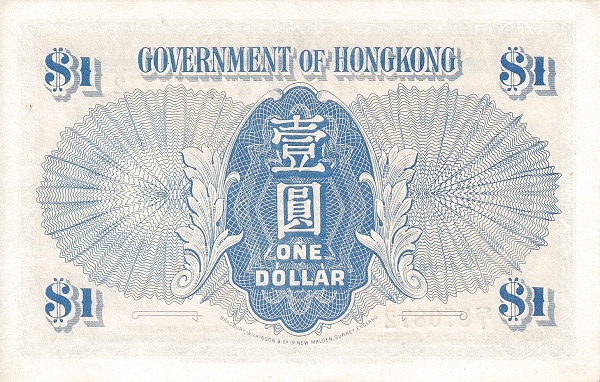
Collector’s perspective
- Pick 316 is the undated blue George VI type.
- The catalogue date ND (1940–1941) and the local 1945 postwar account can be retained together without forcing one to replace the other.
- Original paper, clear blue colour and minimal edge damage are desirable on a type that often saw practical circulation.