
MTR station meetup or local registered mail Card, Apple Pay & Google Pay via Stripe, or Carousell store
USD 1 = HKD 7.8399 · CNY 1 = HKD 1.1666
MTR pickup: free on orders over HK$300 (HK$20 fee below). Local registered mail: HK$30 under HK$1,500, free above. International shipping fees vary by destination.

Blog · Hong Kong Government Subsidiary Notes, 1945–1965

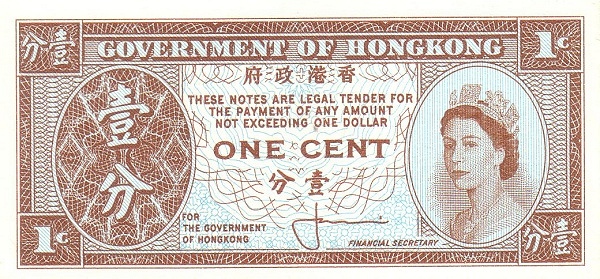
Hong Kong Government Elizabeth II 1 Cent, 1961–1995

P-325 (P-325a–e)

When the royal portrait was updated in 1961, Hong Kong retained the postwar uniface, unnumbered format for Government subsidiary notes. The one-cent value had particular staying power because production of one-cent coins had not resumed after the war.

A long-lived portrait issue

P-325 replaces George VI with Elizabeth II while preserving a face-only layout, Government title and prominent one-cent denomination. With no printed date or individual serial, the Financial Secretary's signature—not a number—is the principal guide to period and variety.

Hong Kong Government Elizabeth II 1 Cent, 1961–1995, Obverse
Obverse of P-325 (P-325a–e). banknote.ws

The small paper denomination outlasted the corresponding five- and ten-cent notes by three decades. That longevity makes P-325 a useful study in continuity: the basic design remained recognisable while the signature changed with successive Financial Secretaries.

Five-signature checklist

  • P-325a — J.J. Cowperthwaite, 1961–1971.
  • P-325b — C.P. Haddon-Cave, 1971–1981.
  • P-325c — Sir J.H. Bremridge, 1981–1986.
  • P-325d — Sir Piers Jacobs, 1986–1992.
  • P-325e — Sir Hamish Macleod, 1992–1995.

P-325 is the only denomination among the Elizabeth II one-, five- and ten-cent Government notes to span all five signature periods. Compare the printed signature carefully with named examples, since neither a date nor serial is available to confirm the attribution.

Hong Kong Government Elizabeth II 1 Cent, 1961–1995, Reverse
Reverse of P-325 (P-325a–e). banknote.ws

The reverse is intentionally blank, continuing the uniface practice established by the George VI issue. Show-through, paper tone and handling marks may be visible, but no printed reverse design or serial should be expected.

Collector's perspective

For this long-running unnumbered type, the signature must remain legible enough for attribution. Check whether folds, stains or abrasion cross the signature, and use the blank back to look for thinning, adhesive residue or repairs; on such a small note, even slight trimming can disturb the border balance.

From George VI to withdrawal

P-325 succeeded the George VI one-cent note without abandoning its uniface concept; the portrait and signatures were the visible updates. Five- and ten-cent paper notes ended after 1965 as coins normalised, but one cent continued until it ceased to be legal tender on 1 October 1995.